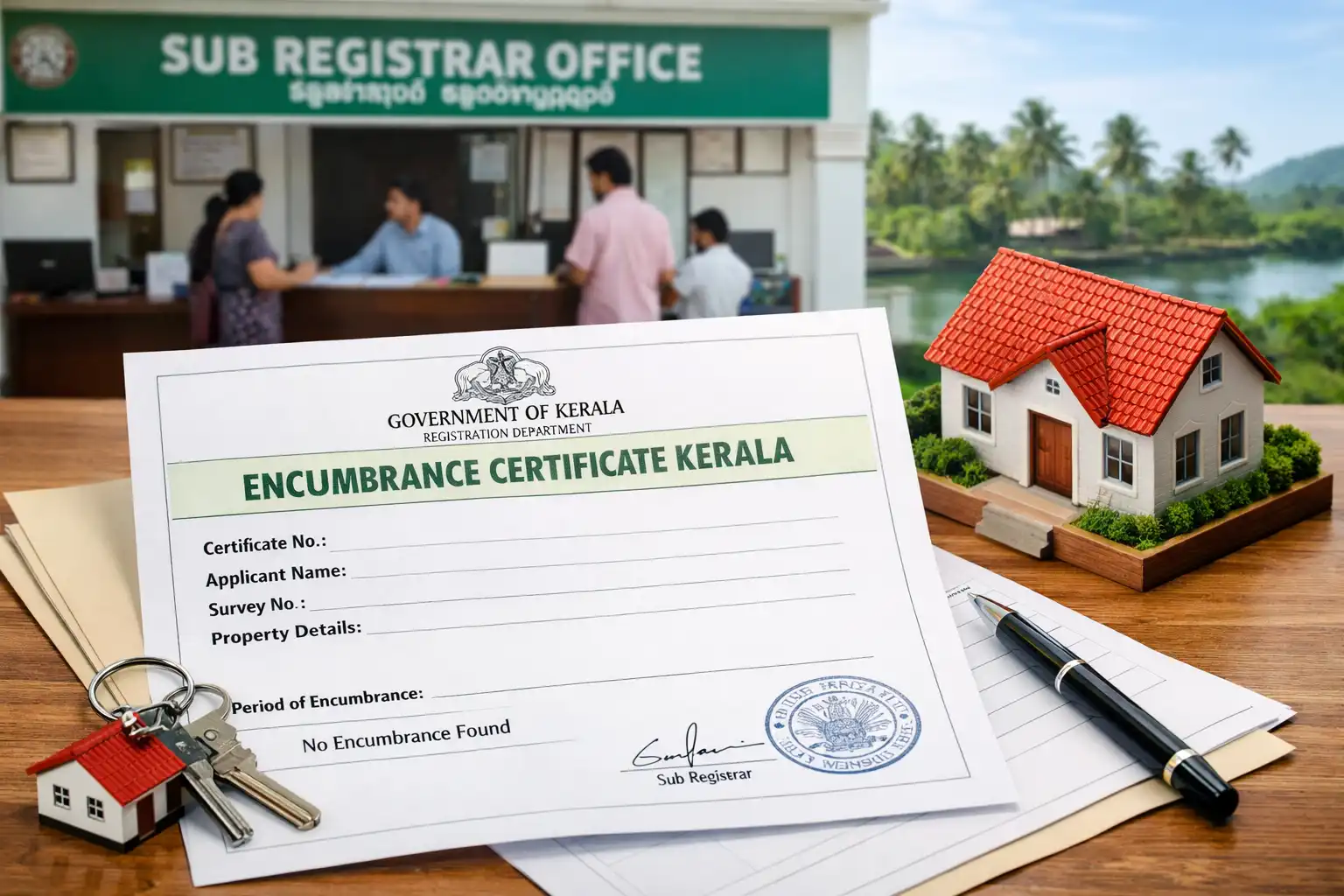
Encumbrance Certificate Kerala Download 2026 Complete Online Guide
An EC is not just for buyers. In 2026, it is required in several real-world scenarios:
Property buyers use it to verify ownership and ensure there are no outstanding loans or disputes. Sellers need it to prove clean title and finalize registrations. Home loan applicants submit ECs to banks as part of loan documentation. Property owners use it to update revenue records or apply for building permits. Legal heirs rely on ECs during succession claims and property mutation processes.
Documents Required To Download Certificate
In most online applications, you do not need to upload documents. However, you must keep accurate property details ready. These typically include:
- Survey number or re-survey number
- Village, taluk, and district
- Document number if available
- Property owner’s name
- Period for which EC is required
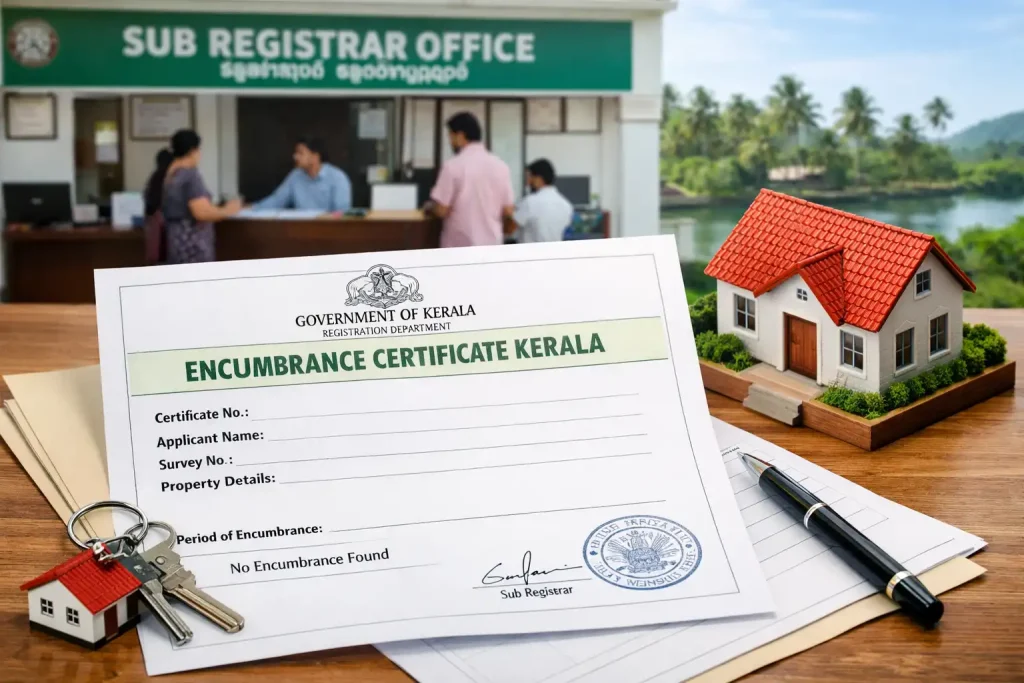
For offline applications at the Sub-Registrar Office, you may also need identity proof and property ownership documents, but online downloads rarely require uploads unless discrepancies arise.
How to Download Encumbrance Certificate Online in Kerala 2026
The Kerala government’s land records portal allows residents to apply for and download ECs online without visiting the Sub-Registrar Office. The system was upgraded in 2025 to reduce errors, speed up processing, and integrate digital signatures.
Below is the complete step-by-step process for encumbrance certificate Kerala download.
Step 1 Access the Official Registration Portal
Open the Kerala Registration Department’s online services platform using a browser on your phone or computer. Choose the Encumbrance Certificate service from the citizen services section.
Step 2 Select Online EC Application
Click on the option to apply for an encumbrance certificate. You will be prompted to enter property-related information.
Step 3 Enter Property Details Carefully
Fill in the district, taluk, village, and property type. Enter the survey number or document number if available. Choose the date range for which you need the certificate. Most buyers request ECs for 20 to 30 years, but banks sometimes ask for 30 years or more.
Accuracy here is critical. Even a small spelling error in the village name or survey number can result in incorrect or blank EC results.
Step 4 Submit Application and Pay Fees
After verifying your details, proceed to payment. Fees can be paid online using net banking, debit cards, credit cards, or UPI.
Step 5 Track Application Status
Once payment is complete, you receive an application reference number. You can use this to track processing status in real time on the portal.
Step 6 Download Digitally Signed EC
After approval, you can download the encumbrance certificate in PDF format. The document includes a digital signature or QR code for authenticity verification. Banks, courts, and government offices accept this digital version in 2026.
Offline Method to Get Encumbrance Certificate
While online EC download is preferred, some users still choose offline mode when:
- Property records are very old and not fully digitized
- Online results show errors or missing entries
- Legal disputes require manual verification
In such cases, you can visit the Sub-Registrar Office where the property is registered, submit Form 22, pay the prescribed fee, and collect the EC after processing. Offline processing typically takes 3 to 10 working days depending on workload and record availability.
Fees for Encumbrance Certificate in Kerala 2026
The Kerala government revised EC charges slightly in late 2025 to standardize online and offline processing costs. Below is a general fee structure.
| Period Requested | Approximate Fee (INR) |
|---|---|
| First year | 15 |
| Each additional year | 10 |
| Nil EC certificate | 15 to 20 |
| Certified physical copy | Additional 20 to 50 |
These fees are indicative and may vary slightly by district or processing method, but online applications remain the cheapest and fastest option.
Encumbrance Certificate for Home Loans and Bank Verification
In 2026, banks in Kerala rely heavily on digital ECs for property loan approvals. Most public and private sector banks require an EC covering at least the last 20 to 30 years. Some housing finance companies insist on longer periods for inherited or jointly owned properties.
Banks use the EC to verify that:
- The seller has legal ownership
- There are no outstanding mortgages or liens
- The property is not involved in court disputes
- Past loans were properly closed
A clean EC significantly improves your chances of faster loan approval and better interest terms because it reduces lender risk.
Frequently Asked Questions
What is the validity period of an encumbrance certificate in Kerala
There is no fixed expiry date, but banks and registrars usually accept ECs issued within the last three to six months for transactions.
Can I download EC for any property in Kerala online
Yes, as long as the property records are digitized and registered, you can apply online. Very old records may require offline verification.
Is online encumbrance certificate legally valid in Kerala
Yes, digitally signed ECs downloaded online are legally valid and accepted by banks, courts, and government offices in 2026.
How many years of EC should I apply for when buying property
Most experts recommend at least 20 to 30 years. For inherited or disputed properties, longer periods may be advisable.
What should I do if my EC shows an old mortgage that is already cleared
You should collect the release deed or loan closure certificate and ensure it is registered. If not, approach the Sub-Registrar Office for rectification.
In today’s fast-moving real estate environment, property verification is no longer optional. With rising land values, increasing inheritance claims, and stricter bank compliance rules, a clean encumbrance certificate has become the foundation of every secure property transaction in Kerala. The state’s digital transformation has made encumbrance certificate Kerala download faster, cheaper, and more reliable than ever before.