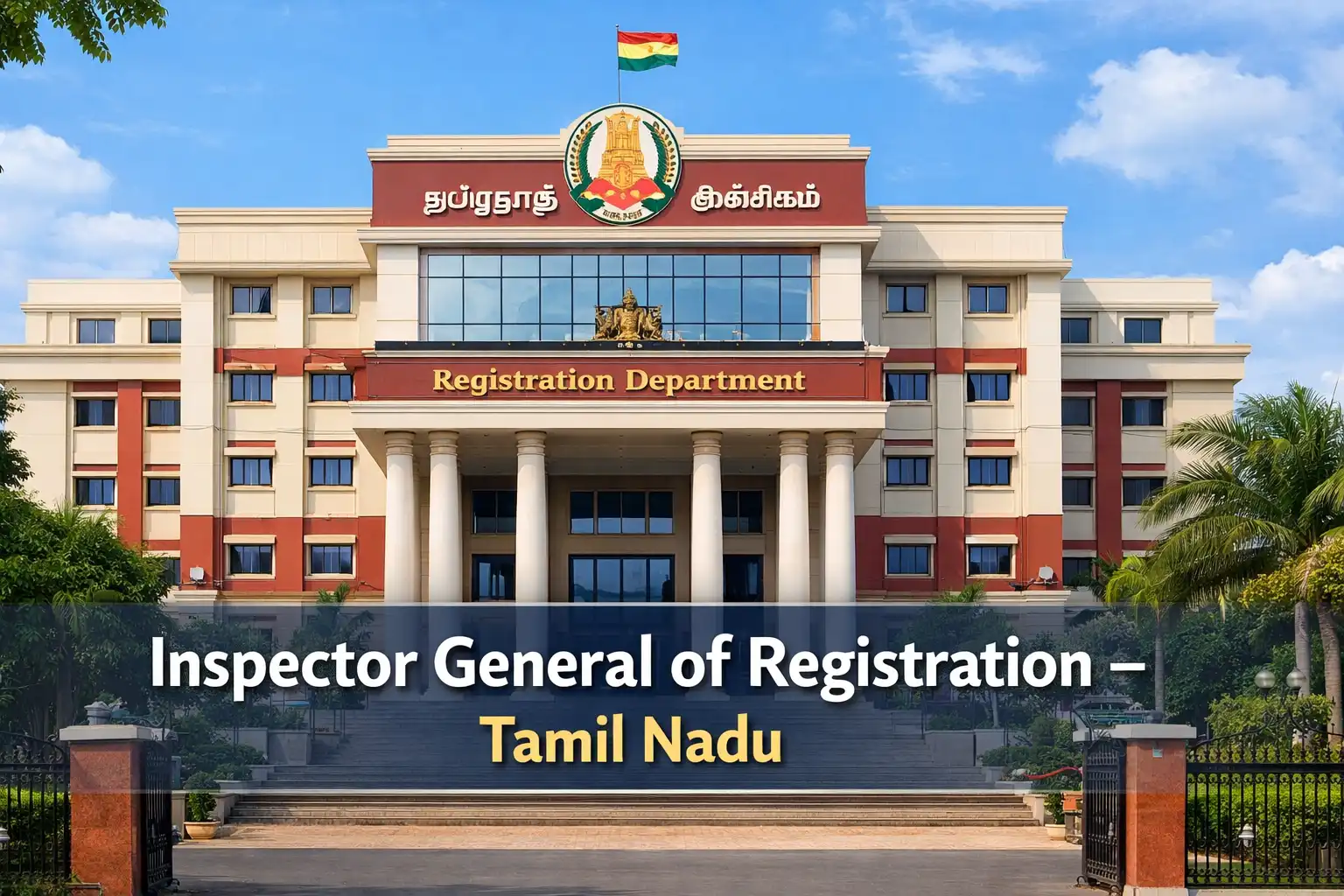
Inspector General of Registration Tamil Nadu 2026 Complete Guide to IGR TN Services
The Inspector General of Registration Tamil Nadu, often called IGR TN, is the head of the Registration Department under the Revenue Administration of the Tamil Nadu Government. This department is responsible for registering documents related to property, marriages, firms, societies, and certain legal instruments.
Unlike many government offices that remain mostly invisible to the public, the IGR’s decisions directly affect everyday life. Buying a house, transferring land, registering a will, or validating a power of attorney all depend on the systems and rules overseen by this office.
Role and Powers of the Inspector General of Registration
The Inspector General of Registration is the administrative and legal head of the Registration Department. The officeholder is typically a senior IAS officer with decades of experience in revenue administration, governance, and law related services.
The IGR’s powers extend beyond supervision. The office sets policy direction, issues circulars, resolves valuation disputes, and acts as the final authority in many registration related appeals.
Core Responsibilities
The Inspector General of Registration Tamil Nadu is responsible for:
- Supervising all sub registrar and district registrar offices
- Implementing registration laws and stamp duty rules
- Fixing property guideline values through valuation committees
- Approving digital reforms and citizen service initiatives
- Conducting audits and inspections of registration offices
- Resolving complaints and disciplinary matters
Through these functions, the IGR ensures that document registration across Tamil Nadu remains legally sound, efficient, and corruption resistant.
Role and Powers of the Inspector General of Registration
The Inspector General of Registration is the administrative and legal head of the Registration Department. The officeholder is typically a senior IAS officer with decades of experience in revenue administration, governance, and law related services.
The IGR’s powers extend beyond supervision. The office sets policy direction, issues circulars, resolves valuation disputes, and acts as the final authority in many registration related appeals.
Core Responsibilities
The Inspector General of Registration Tamil Nadu is responsible for:
- Supervising all sub registrar and district registrar offices
- Implementing registration laws and stamp duty rules
- Fixing property guideline values through valuation committees
- Approving digital reforms and citizen service initiatives
- Conducting audits and inspections of registration offices
- Resolving complaints and disciplinary matters
Through these functions, the IGR ensures that document registration across Tamil Nadu remains legally sound, efficient, and corruption resistant.
Organizational Structure Under the IGR Office
The Registration Department functions through a layered administrative structure that ensures uniformity across all districts.
Key Levels in the Department
- Inspector General of Registration
- Additional Inspector Generals
- Deputy Inspector Generals at zone level
- District Registrars
- Sub Registrars at local offices
Each sub registrar office serves as the frontline registration authority for citizens, while district and zonal officers handle supervision, dispute resolution, and compliance monitoring. The Inspector General of Registration coordinates all these levels into a unified administrative system.
Major Services Offered by the Registration Department in 2026
In 2026, the Registration Department offers a wide range of citizen services, many of which are now fully online or digitally assisted.
Property Registration Services
Property transactions remain the most common service category. These include sale deeds, gift deeds, settlement deeds, mortgages, lease agreements, partition deeds, and powers of attorney.
The department now provides:
- Online appointment booking
- Pre calculation of stamp duty and registration fees
- Biometric authentication
- Digital document storage
- Instant encumbrance certificate downloads
These improvements significantly reduce waiting times and eliminate manual errors.
Marriage Registration
The department registers Hindu marriages, Special Marriage Act marriages, and other personal law marriages. Couples can now:
- Apply online
- Upload supporting documents
- Book registration slots
- Track certificate issuance digitally
Marriage certificates issued through the system are accepted across government departments and foreign embassies.
Firm, Society, and Trust Registration
Businesses and nonprofit organizations also depend on the Registration Department for legal recognition. In 2026, firm registration, society registration, and trust registration can be initiated online with document uploads, fee payments, and status tracking.
This modernization has reduced processing timelines from weeks to days in many districts.
Encumbrance Certificates and Land Records
Encumbrance certificates are essential for verifying property ownership and financial liabilities. The department’s digitized databases allow instant retrieval of ECs in most areas dating back decades.
Land records digitization, although administered primarily by revenue departments, is closely integrated with the registration system to prevent overlapping ownership claims.
Digital Transformation and Smart Registration Systems
One of the biggest achievements of the Inspector General of Registration Tamil Nadu in recent years is the complete overhaul of legacy systems.
Key Digital Milestones
- Statewide biometric authentication for executants and witnesses
- Online slot booking and digital fee payment
- QR coded registration receipts and certificates
- Centralized document archival with secure retrieval
- Integrated valuation software linked to guideline values
In 2026, citizens can complete most of their documentation preparation before ever stepping into a sub registrar office, reducing average transaction time from hours to minutes.
Salary, Rank, and Career Structure of the Inspector General of Registration
The Inspector General of Registration Tamil Nadu is usually a senior IAS officer posted at Secretary or Commissioner level in the state administration.
Salary and Service Benefits 2026
| Position | Pay Scale (Approx) | Monthly Salary (2026 Est.) | Additional Benefits |
|---|---|---|---|
| Inspector General of Registration | Level 15 IAS Pay Matrix | ₹1,82,000 to ₹2,05,000 | Government residence, staff, vehicle, allowances |
In addition to salary, the IGR receives official accommodation, staff support, transport facilities, and other service benefits typical of senior civil service positions.
Frequently Asked Questions
What is the role of the Inspector General of Registration Tamil Nadu?
The Inspector General of Registration is the head of the Registration Department, responsible for overseeing property registrations, stamp duty enforcement, digital systems, grievance redressal, and policy implementation across the state.
Can I complete property registration fully online in Tamil Nadu in 2026?
Most steps including document preparation, appointment booking, fee payment, and verification can be completed online, but physical presence is still required for biometric authentication and final execution.
What is the salary of the Inspector General of Registration?
In 2026, the IGR typically earns between ₹1.82 lakh and ₹2.05 lakh per month excluding allowances and government provided benefits.
How can I file a complaint against a sub registrar office?
Complaints can be submitted through the department’s grievance portals, email systems, or directly to district registrars, with escalation to the IGR office if unresolved.
Does the IGR office handle marriage and firm registrations?
Yes, the Registration Department under the IGR registers marriages, firms, societies, trusts, and certain legal instruments in addition to property transactions.
The Inspector General of Registration Tamil Nadu is far more than an administrative title. In 2026, this office stands at the center of property security, digital governance, and public trust in legal documentation. From preventing fraud and enabling fast online registrations to safeguarding land ownership and strengthening economic confidence, the IGR system quietly shapes millions of lives every year.